10 backends in 12 months, and only 3 ever served a customer
EngineeringRuby on RailsRustNestJSTanStack StartScope

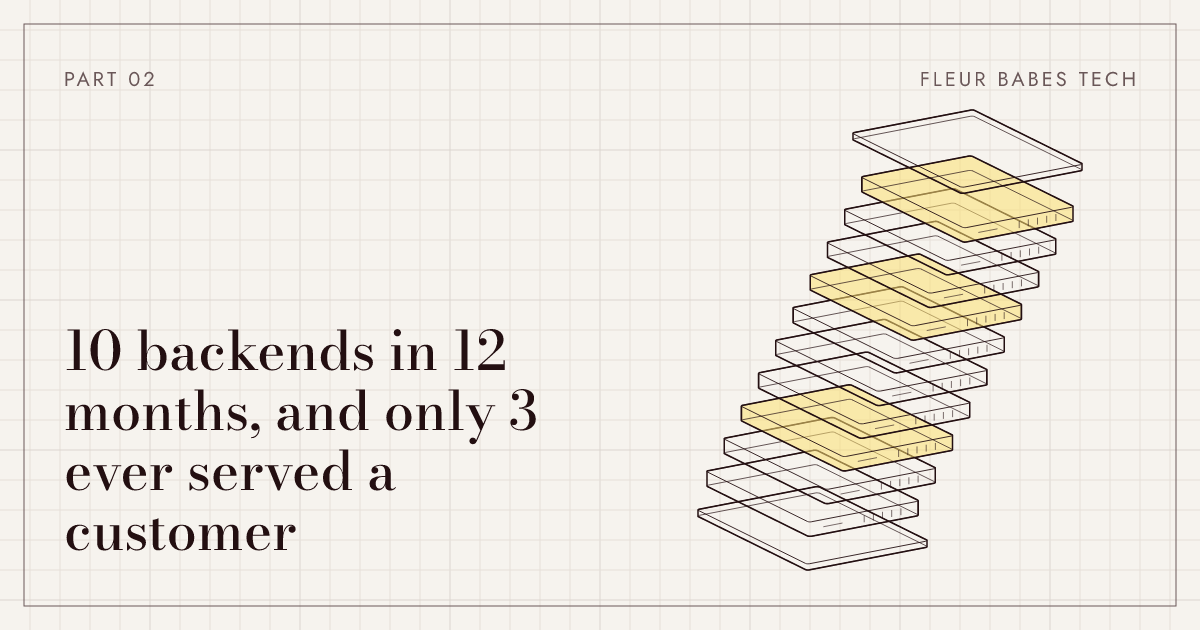
Between Payload CMS and Flair v1 I wrote seven backends no customer ever saw: 10 in all, counting the 3 that did. Most rebuilt the same thing, because I hadn't decided what we were building.
On 29 December 2025 I started a new backend in NestJS. The next day I started another one in Rust. By 31 December there was a third, in Ruby on Rails.
None of them was for a customer. Charm was already in production, and staff were entering every WhatsApp order into it. These three were experiments. They were not the last ones.
The list
Counting the systems that served real customers, Fleur Babes had three before Flair v2: the Payload CMS online store, Charm, and Flair v1. Around them, I wrote seven more backends. Here they are in order.
| Repo | When | Stack | How far it got |
|---|---|---|---|
| charm-nest | Dec 2025 | NestJS, Drizzle ORM | 3 commits, one day |
| charm-rs | Dec 2025 | Rust, layered crates | 12 commits in a day; Google sign-in, mobile tokens |
| charm-rails | Dec 2025 | Rails 8.1 API | 32 commits; a solid multi-tenant API |
| charm-adonis + charm-expo | Jan 2026 | AdonisJS API, Expo app | About halfway; the app had auth, tabs, a calendar |
| charm-2026 | Feb 2026 | Nest, mobile monorepo | 32 commits in one day |
| charm-rts | May 2026 | Rails API, TanStack Start | 56 commits, nearly done |
| charm-start | Jun–Aug 2026 | TanStack Start, PocketBase | 123 commits |
That’s ten backends if you count Payload, Charm and Flair v1. Only three of them ever took an order.
Why I kept starting again
Part of it was learning. Each new stack taught me something. Part of it was that AI made a rewrite feel cheap, so starting again never felt like a big decision.
And the models kept changing under me. In 2025 I coded with Trae, then paid for Cursor. Through Cursor I used the frontier models, and Cursor’s own Composer model too. From December 2025 to April 2026, whenever I hit Cursor’s limits, I switched to DeepSeek and carried on. In April 2026 I started paying for ChatGPT. Between April and October, OpenAI shipped a new model family every few months: GPT-5.5 in April, GPT-5.6 in the summer, GPT-6 in September. Each was better than the last, and trained on more recent code, so it knew the newer libraries I wanted to try.
That’s a big part of why an experiment felt cheap. If the last attempt stalled, the next model might carry it further, so starting again seemed worth it. But none of those models was as good as Opus 5.5 is now. They could start a project quickly. Finishing one was harder.
The difference between last December’s models and this November’s is trust. Today I can hand over far more of the work, and let agents review each other’s code, as long as there are proper guardrails and tests.
But the bigger reason only shows when you lay the repos side by side. Almost every one rebuilt the same multi-tenant schema: brands, team members, invitations, a generic “confirmation” that could be an order, an appointment or a subscription. Each time it had more architecture around it. Domain crates in Rust. Use cases and optimistic locking in Nest.
Every one of those layers was code I’d have to keep working for as long as the app lived. That’s the real price of a backend: not writing it, but carrying it.
I was rebuilding Charm’s shape in a new language, and Charm’s shape was the problem. It was designed for many businesses. We were one.
The one that was hard to let go
charm-rts was the hardest to drop. It was a Rails API with a TanStack Start front end, 56 commits, and it was nearly done. It had CHIP payments, geocoded address search and autosave on forms.
Those features matter, and here is why. They were the first genuinely new things in any of the experiments. And they only appeared once I stopped designing for “boutique businesses” in general. I started working through Fleur Babes’ own orders instead: how we take payment, how we find a delivery address, how a long form keeps what staff have typed.
So the answer to “learning, or avoiding the real problem?” is both. The languages were learning. The repeated multi-tenant schema was avoidance. The real problem was scope: I didn’t yet know exactly which features we needed, so I kept rebuilding the parts I already understood. Flair v2 started the other way round, with a spec before any code.
The lessonA new stack can’t fix a scope you haven’t decided.
What I’d tell a developer about to start again
- Write down what the last version did that this one won’t. If the list is empty, you’re changing the stack, not the product.
- Build your own business first. Multi-tenant can come later, if anyone asks.
- Look for the first new feature. If the experiment only rebuilds what you have, stop early.
- Tell the people around you what you’re building. Saying it out loud is a cheap scope check.
Charm, the one that did serve customers, had its own problem. Every screen took a second or two to open, and I knew exactly why.
Stuck between rewrites? Let's pin down the scope first.
Book a free callSystem review · build work · fractional CTO